Dec
Understanding PDLC Switchable Smart Film Technology: Privacy on Demand
In the realm of architectural innovation, few products offer the seamless blend of technology and design like switchable smart film. At the heart of this revolution is PDLC (Polymer-Dispersed Liquid Crystal) film, a core technology that transforms ordinary glass surfaces into dynamic, privacy-on-demand partitions. For designers, facility managers, and homeowners seeking to modernize their spaces, understanding the mechanics of PDLC film is key to harnessing its full potential.
What is PDLC Film? A Look Inside the Technology
PDLC film is an electro-optical material engineered to instantly change its state from opaque to transparent. This action is not driven by moving parts, but by an electronic reaction that alters the alignment of microscopic liquid crystals embedded within the film.
The Core Structure
The structure of PDLC film is a highly specialized laminate, typically composed of five key layers:
-
Outer Layers (PET Film): Two layers of durable Polyethylene Terephthalate (PET) film form the protective exterior of the sandwich.
-
Conductive Layers (ITO): Thin, transparent layers of Indium Tin Oxide (ITO) are coated onto the PET film. These layers conduct the low-voltage electrical current required for switching.
-
The PDLC Layer: This central layer is where the magic happens. It consists of millions of microscopic liquid crystal droplets dispersed uniformly throughout a polymer matrix.
How Does the Switching Mechanism Work?
The process is instant and entirely reversible:
-
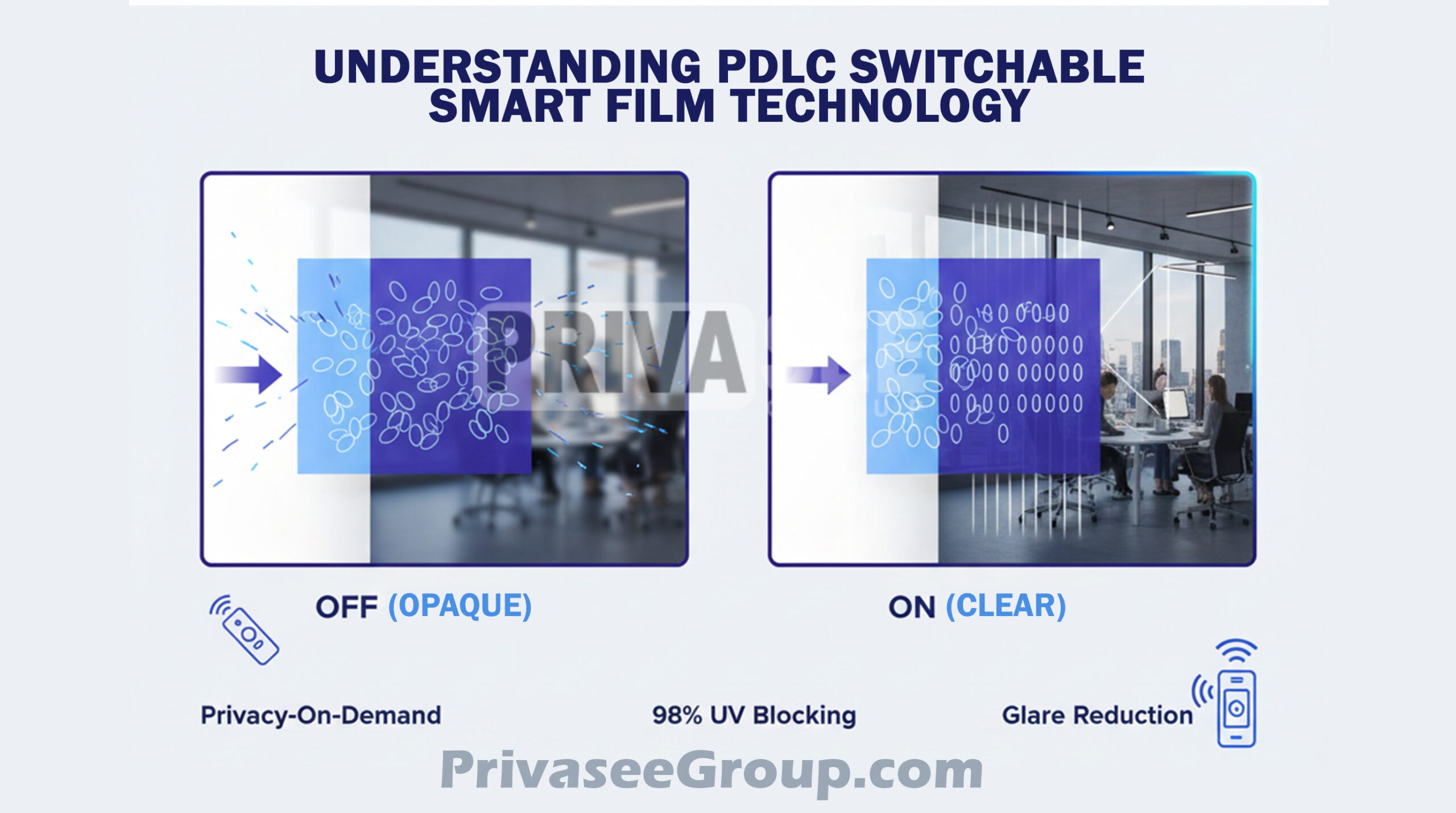
OFF State (Opaque/Frosted): When the power is turned off, the liquid crystals within the polymer matrix are randomly scattered and unaligned. When light hits this layer, it is refracted and scattered by the misaligned crystals, causing the glass to appear frosted and opaque, offering complete visual privacy.
-
ON State (Clear/Transparent): When a low-voltage electrical current is applied (power is turned on), the electrical field causes the liquid crystals to instantly align themselves in a parallel configuration. When aligned, light passes straight through the glass, making it appear clear (transparent).
Control and Integration
One of the greatest appeals of PDLC switchable film is its ease of control and integration into modern systems:
-
Simple Switching: The most basic method is a standard wall switch.
-
Remote Control: A dedicated remote allows for easy operation from anywhere in the room.
-
Home/Building Automation: For advanced projects, the film can be seamlessly integrated into existing smart home systems (like Z-Wave, Zigbee, or KNX), allowing operation via voice command, smartphone app, or programmed timers.
-
Sensors: PDLC film can also be connected to motion sensors or light sensors for automated control based on occupancy or ambient conditions.
Beyond Privacy: Additional Key Benefits
While privacy-on-demand without the need for curtains or blinds is the film's signature feature, PDLC technology delivers crucial performance advantages that contribute to a healthier and more energy-efficient environment:
-
UV Blocking: In both the clear and frosted states, PDLC film typically blocks over 98% of harmful ultraviolet (UV) radiation. This is vital for protecting interior furnishings, artwork, and flooring from fading and degradation.
-
Glare Reduction: In its opaque state, the film acts as a natural diffuser. It filters harsh, direct sunlight, dramatically reducing glare while still allowing soft, ambient light to penetrate the space. This is highly beneficial for offices, schools, and medical facilities.
-
Acoustic Insulation: When applied to glass, the layered structure of the film can offer a marginal improvement in sound dampening, enhancing the acoustic comfort of a room.
Conclusion
PDLC switchable smart film is more than just a novelty; it is a foundational technology for dynamic architecture. By offering instantaneous privacy, reducing UV exposure, and minimizing glare, it provides an elegant and technologically advanced alternative to traditional window treatments. It transforms static glass walls into flexible, multifunctional surfaces, providing architects and designers with unparalleled control over light, space, and privacy.
For high-quality supplies and installation, shop all your project needs. For custom assistance or pricing, get a quotation today.
Share this post

RELATED
Posts
Switchable Smart Film vs Smart Glass: Which One Should You Choose?
The Tech Guide: Integrating Smart Glass with Home Automation